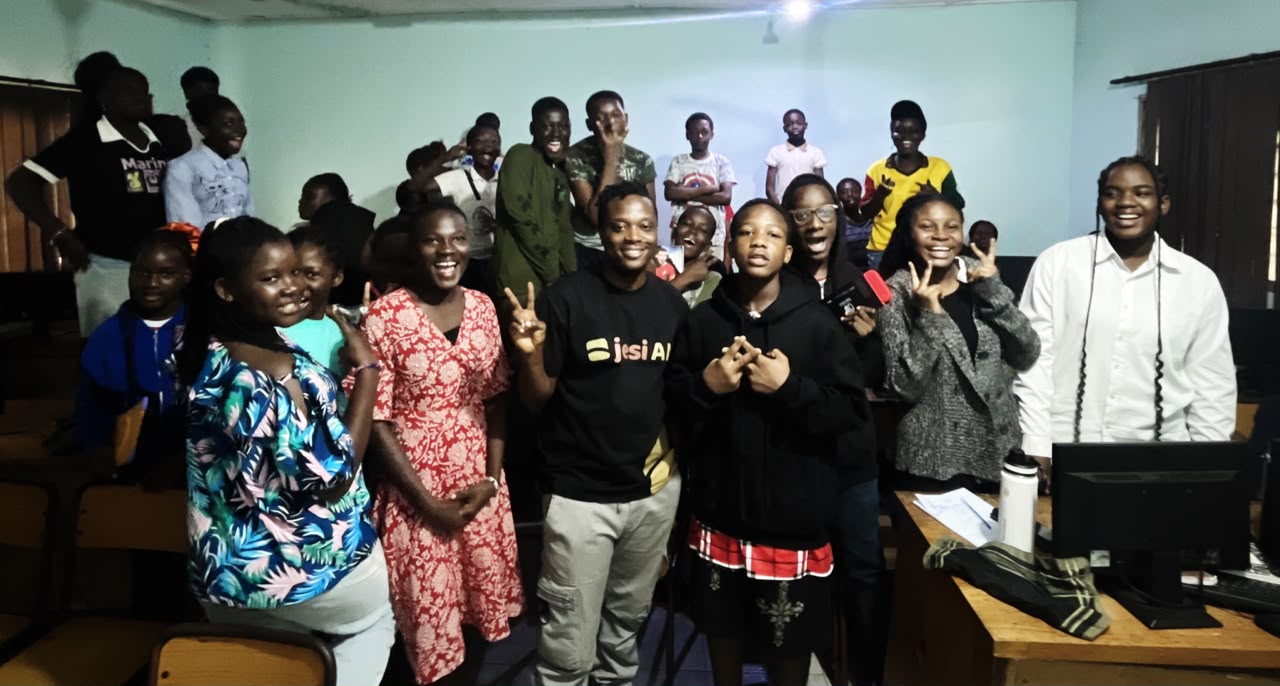
Last week, the Jesi AI team was invited to lead a session on “How to Learn in the Age of AI” as part of a summer school programme in Accra.
Our first class was made up of 30 Basic 7–9 students, mostly between the ages of 12 and 15. I thought I was going there to teach them about AI. I ended up learning almost as much from them. The first hour was a trial by fire. Holding the attention of 30 energetic teenagers on a warm afternoon is an endurance sport. I lost count of how many times I had to ask the class to keep quiet.
Then we brought out the devices, and almost immediately, the room changed. Once the students were onboarded onto Jesi AI and started experimenting for themselves, the same students who struggled to sit through my explanations became intensely curious. They wanted to try questions, challenge the AI, compare answers and explore what else it could do.
At the end of the session, one boy came up to me with some unsolicited feedback:
“I really enjoyed the practical session using Jesi AI. Next time, skip the long explanations part.”
Fair point. Beyond reminding me that I probably shouldn’t become a full-time JHS teacher anytime soon, the experience left me thinking about what AI adoption in African classrooms will actually require. Three lessons stood out.
1. Students already use AI. We need to teach them how to learn with it.
I started the session with a simple question:
“Which AI tools do you know or use?”
Hands went up immediately. The students could name many of the popular AI chatbots. Clearly, AI had already entered their world.
But my next question was more revealing:
“What do you use them for?”
For many of them, the answer was homework. Not necessarily to understand the homework, but to get the answer quickly, submit it and move on to something more interesting.
That distinction matters. The challenge facing schools is no longer whether students will use AI. They already are. The challenge is whether they will use it to avoid learning or to deepen it.
During the practical session, we explored a different approach.Instead of asking AI to simply answer a question, students learned to ask it to explain difficult concepts in simpler language. They used it to generate practice questions, brainstorm ideas, research unfamiliar topics and test their understanding.
We were trying to move their mental model from: “AI, give me the answer.” to: “AI, help me understand.”
That may be one of the most important AI literacy skills we can teach young people.
There is also a prompting and critical-thinking gap. Students need to know how to ask clear questions, provide useful context, interrogate an AI-generated response and recognise that AI can confidently produce incorrect information.
One of my favourite moments came when a student told us she sometimes insults an AI chatbot when it gives her the wrong answer. She couldn’t understand why, no matter what she said, it remained polite. The whole class burst into laughter.
But underneath the joke was something important: these young people are developing relationships and habits around AI in real time. Schools have an opportunity to shape those habits before they become permanent.
This is also part of the thinking behind Jesi AI. We are exploring what AI learning experiences can look like when they are designed around the curriculum and realities of African students rather than expecting learners to figure out general-purpose AI tools entirely on their own.
2. Teachers cannot be spectators in the AI transition.
One thing became clear to me during the session: we cannot teach millions of students how to use AI responsibly one workshop at a time. Teachers are the multiplier.
A good teacher does much more than transfer information. Teachers help students make sense of knowledge, ask better questions, develop discipline and learn how to think. I believe AI doesn’t make that role less important; it makes it more important.
If students have instant access to machines capable of generating answers, explanations, essays and ideas, they will need adults who can help them distinguish between getting an answer and actually understanding something. That means AI literacy cannot remain the responsibility of ICT teachers alone. Maths, Science, English, Social studies teachers and school leaders need it.
After our student session, some teachers approached us wanting to understand how they could use AI in their own work and classrooms. Their interest reinforced why we started our AI4T – AI for Teachers programme, through which we have been introducing educators to practical AI literacy and helping them explore how these tools can support teaching.
If we want responsible AI adoption in schools to happen at scale, teachers may be our most important distribution channel.
Train one student and you impact one learner. Equip one teacher and that knowledge can reach hundreds of students over the course of their career.
3. Digital safety education is falling behind AI adoption.
The part of the session that concerned me most came toward the end. We started discussing digital safety and asked students what information they should never share with an AI chatbot or other public digital platforms. As we went through examples of sensitive personal information, I could see expressions changing around the room. Some students realised they had already shared information online that they probably shouldn’t have.
That was a wake-up call for me. Young people are adopting new technologies much faster than our systems are teaching them how to navigate those technologies safely. AI literacy therefore cannot only be about prompting and productivity. It must also include privacy, verification, consent, digital footprints, misinformation and responsible behaviour.
We also discussed the ethics of using AI to manipulate images and videos of other people. What might seem like a funny experiment involving a classmate’s photo can cause genuine harm and potentially have serious consequences.
These conversations need to happen before something goes wrong, not afterwards. And again, teachers can play an important role. Instead of relying entirely on occasional cyber-awareness campaigns, we can equip teachers with simple, practical AI safety lessons they can continuously reinforce in classrooms.
What I took away
I went into the classroom thinking about how we could teach teenagers to use AI. I left thinking about a much bigger question:
How do we prepare an entire generation to learn in a world where answers are becoming almost free and instantly available?
I don’t think the answer is banning AI from classrooms. And it certainly isn’t pretending students aren’t already using it. We need to teach students that getting an answer is not the same as learning.
We need to equip teachers to become confident guides in an AI-enabled classroom.
We need to make digital safety part of AI literacy from the beginning.
And perhaps most importantly, we need to build technology that reflects the curriculum, context and realities of the students we expect to use it. For me, that is part of what makes building Jesi AI exciting. We are not simply trying to put another chatbot in the hands of African students.
We are trying to understand what it means to learn well in the age of AI—and build tools that help students and teachers do exactly that. Thirty teenagers in an Accra classroom gave me a few more clues.
And next time, I promise to keep the AI explanations shorter.